How Your Portfolio Should Respond to Rising AI Borrowing Costs
It was a rough start to the fourth quarter for Technology stocks. In the week ending October 16, the Nasdaq Composite fell approximately 4.5%, as investors started to scrutinize borrowing costs associated with the AI infrastructure buildout.
In this week’s column, I’m going to reference specific companies to illustrate where some of the financing pressure was coming from. But please note, references to individual companies are for illustrative purposes only and are not recommendations to buy, sell, or hold any security.
The biggest company driving investor concern was CoreWeave, which provides cloud computing capacity for AI. The company had issued unsecured bonds in June with a 9.625% annual coupon, but by the end of last week, reports put yields on some of its bonds at roughly 15%–16%. Credit investors were demanding substantially greater compensation to own its debt. 1
The distinction between the coupon and market yield is important. Falling bond prices do not automatically increase interest payments on existing fixed-rate debt. They do, however, indicate the returns investors may require for future borrowing or refinancing.
CoreWeave’s quarterly results make this financing challenge tangible. Second-quarter revenue more than doubled to $2.58 billion, but the company reported $640 million in net interest expense and a $626 million net loss. Rising demand for CoreWeave’s services is coexisting with rising financing expense, which leaves less room for delays or disappointing returns.2
How Could AI Financing Pressures Affect the Market?
As investors weigh the cost of funding the AI buildout, questions about borrowing costs and profitability are coming into focus. What could these pressures mean for technology stocks and the broader market?
Get a closer look at the forces shaping stocks and the economy in our October Stock Market Outlook Report3, with insights to help you make informed investment decisions.
Inside, you’ll learn:
- Asset allocation guidelines for today’s market environment
- Expert forecasts for inflation, rates, and economic trends
- Industry tables and rankings to help you spot opportunities
- Buy-side and sell-side consensus insights at a glance
- And much more!
Claim your complimentary copy of the report to learn how higher interest rates and changing economic conditions could affect your portfolio in the months ahead.
Download our October Stock Market Outlook Report3
Over last weekend, Reuters reported that Anthropic was offering a yield exceeding 10% on a proposed $9 billion financing involving Blackstone funds, backed by five years of chip-lease payments. Anthropic is being held out as one of the most promising frontier labs, but 10% yields on $9 billion represents a substantial financing cost to carry as the investment generates returns.2
I think these financing risks warrant caution, particularly when a portfolio depends heavily on companies borrowing to fund rapid expansion. And even though it may seem like Technology is the only game in town, I think investors have a much wider range of businesses to consider—with different capital requirements and sources of profit. The latest earnings estimates give us a useful picture of those opportunities.
According to our colleagues at Zacks Investment Research, third-quarter S&P 500 earnings are expected to increase 24.6% year-over-year on 11.7% higher revenues. Removing Technology reduces expected earnings growth to 14.4%, but double-digit growth across the rest of the index is still an encouraging starting point.
The breadth is encouraging: 14 of the 16 Zacks sectors are expected to report positive earnings growth. And looking ahead, upward fourth-quarter revisions extend into Aerospace, Construction, Industrials, Finance, and Transportation. That gives investors evidence of improving profit expectations outside the companies at the center of the AI financing debate.
These are forecasts that incoming results will test, which we’ll of course be watching closely.
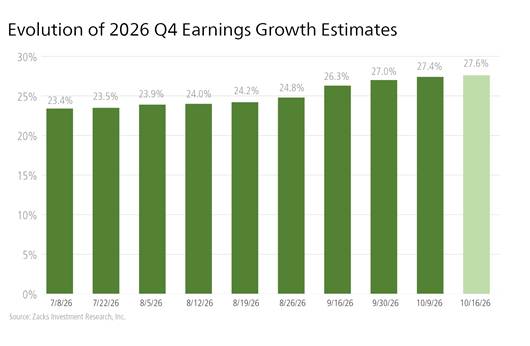
Valuations also differ substantially across the market. At the start of October, the equal-weight S&P 500 traded at approximately 15x expected earnings over the next 12 months, compared with about 19x for the traditional S&P 500 Index. That gap suggests investors can find stocks trading at more attractive valuations outside the market’s largest companies.
That leaves opportunities to evaluate growing businesses at more modest valuations. A lower multiple still requires scrutiny, but investors have a much wider set of choices than the handful of companies attracting the most headlines, in my view.
Going forward, the financing concerns deserve continued attention. A sustained reduction in AI investment could affect equipment suppliers and lenders beyond the borrowers themselves. I would become more concerned if those pressures began producing widespread earnings downgrades or making credit harder to obtain across unrelated industries. For now, the Zacks earnings outlook supports a broader search for opportunities. Investors can assess cash generation and valuations across sectors while keeping exposure to any single financing cycle (in this case, AI) in proportion.
Bottom Line for Investors
The recent selloff is a useful opportunity to examine how much of a portfolio depends on the same outcome. Several holdings can carry different company names while relying on the same capital-spending cycle.
In my view, diversification means giving a portfolio multiple ways to make progress. There is room to participate in AI, while also owning businesses with different customers, financing needs, and sources of profit. That flexibility becomes particularly valuable when one of the market’s most prominent growth themes faces a more demanding financial test, as we may be seeing now.
Keeping that broader perspective starts with understanding the forces shaping the market. Our October Stock Market Outlook Report³ takes a closer look at economic developments and market trends to help you evaluate opportunities and make informed investment decisions. Download your free copy today.
Inside, you’ll learn:
- Asset allocation guidelines for today’s market environment
- Expert forecasts for inflation, rates, and economic trends
- Industry tables and rankings to help you spot opportunities
- Buy-side and sell-side consensus insights at a glance
- And much more!
Claim your complimentary copy of the report to learn how higher interest rates and changing economic conditions could affect your portfolio in the months ahead.
Download our October Stock Market Outlook Report3
Disclosure
2 Zacks Investment Research. October 16, 2026. “Q3 Earnings Season Preview: Revenue Beats Lag, Multi-Sector Momentum Holds.”
3 Zacks Investment Management reserves the right to amend the terms or rescind the free October Stock Market Outlook Report offer at any time and for any reason at its discretion.
DISCLOSURE
Past performance is no guarantee of future results. Inherent in any investment is the potential for loss.
Zacks Investment Management, Inc. is a wholly-owned subsidiary of Zacks Investment Research. Zacks Investment Management is an independent Registered Investment Advisory firm and acts as an investment manager for individuals and institutions. Zacks Investment Research is a provider of earnings data and other financial data to institutions and to individuals.
This material is being provided for informational purposes only and nothing herein constitutes investment, legal, accounting or tax advice, or a recommendation to buy, sell or hold a security. Do not act or rely upon the information and advice given in this publication without seeking the services of competent and professional legal, tax, or accounting counsel. Publication and distribution of this article is not intended to create, and the information contained herein does not constitute, an attorney-client relationship. No recommendation or advice is being given as to whether any investment or strategy is suitable for a particular investor. It should not be assumed that any investments in securities, companies, sectors or markets identified and described were or will be profitable. All information is current as of the date of herein and is subject to change without notice. Any views or opinions expressed may not reflect those of the firm as a whole.
Any projections, targets, or estimates in this report are forward looking statements and are based on the firm’s research, analysis, and assumptions. Due to rapidly changing market conditions and the complexity of investment decisions, supplemental information and other sources may be required to make informed investment decisions based on your individual investment objectives and suitability specifications. All expressions of opinions are subject to change without notice. Clients should seek financial advice regarding the appropriateness of investing in any security or investment strategy discussed in this presentation.
Certain economic and market information contained herein has been obtained from published sources prepared by other parties. Zacks Investment Management does not assume any responsibility for the accuracy or completeness of such information. Further, no third party has assumed responsibility for independently verifying the information contained herein and accordingly no such persons make any representations with respect to the accuracy, completeness or reasonableness of the information provided herein. Unless otherwise indicated, market analysis and conclusions are based upon opinions or assumptions that Zacks Investment Management considers to be reasonable. Any investment inherently involves a high degree of risk, beyond any specific risks discussed herein.
The S&P 500 Index is a well-known, unmanaged index of the prices of 500 large-company common stocks, mainly blue-chip stocks, selected by Standard & Poor’s. The S&P 500 Index assumes reinvestment of dividends but does not reflect advisory fees. The volatility of the benchmark may be materially different from the individual performance obtained by a specific investor. An investor cannot invest directly in an index.
The Nasdaq Composite Index measures all Nasdaq domestic and international based common type stocks listed on The Nasdaq Stock Market. To be eligible for inclusion in the Index, the security's U.S. listing must be exclusively on The Nasdaq Stock Market (unless the security was dually listed on another U.S. market prior to January 1, 2004 and has continuously maintained such listing). The security types eligible for the Index include common stocks, ordinary shares, ADRs, shares of beneficial interest or limited partnership interests and tracking stocks. Security types not included in the Index are closed-end funds, convertible debentures, exchange traded funds, preferred stocks, rights, warrants, units and other derivative securities. An investor cannot invest directly in an index.