Steady Investor Weekly
Markets continue to evolve as investors assess the latest economic developments. This week’s Steady Investor takes a closer look at what’s shaping the outlook, including:
- The Fed holds rates steady
- U.S. manufacturing jobs rise
- AI drives bank lending growth
The Fed Holds Rates Steady, But Another Hike is Expected in 2026 – As widely expected, the Federal Reserve held interest rates steady at its October meeting, following a quarter-point hike last month. The benchmark fed funds rate now sits at 3.75%–4.00%. Fed Chairman Kevin Warsh acknowledged that the U.S. economy continues to expand at a strong pace, supported by resilient consumer spending, robust capital investment, and a relatively stable labor market. The issue is that a strong economy is being accompanied by stubborn inflation, which has been stuck above the Fed’s 2% target for more than five years. The energy effect remains the biggest driver of higher prices in 2026, but signs are emerging that these higher costs are starting to trickle through to other parts of the economy. As of this writing, the pressures on other areas like transportation costs, consumer goods, services, and housing remain fairly modest. But the strong nominal growth combined with sticky price pressures have markets pricing-in another rate hike in December, which we also expect to see.1
How to Safeguard Your Retirement from Inflation’s Impact
The Fed’s latest decision is a reminder that inflation remains part of the economic picture. But for retirement savers, the bigger question is how rising costs could affect your purchasing power over the years ahead.
Whether you’re approaching retirement or already there, reviewing your investment mix, spending, and income sources can help you prepare.
Our free guide, 4 Ways to Protect Your Retirement from Rising Inflation², explores:
- How to build or modify your asset allocation to outperform inflation
- The importance of analyzing your spending by category
- Strategies to maximize Social Security retirement benefits
- Plus, more practical ideas to fight back against inflation
Claim your complimentary guide to explore ways to help your retirement savings go further. Download 4 Ways to Protect Your Retirement from Inflation2.
U.S. Manufacturing Jobs are Coming Back, But They’re Not Like the Old Ones – After years of declining employment, U.S. manufacturing is beginning to add jobs again.3
All Employees, Manufacturing
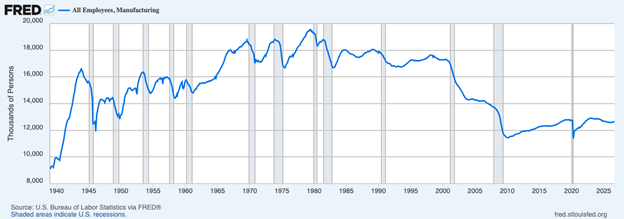
The newly hired positions look considerably different from traditional factory work. Manufacturers have added approximately 72,000 workers since December of last year, with hiring increasingly concentrated in technology-intensive industries such as aerospace, semiconductors, and electrical equipment. The longer-term shift is even more striking. Between 2015 and 2025, U.S. manufacturers eliminated 244,000 production jobs, including assembly and machine-operation roles, while adding 358,000 positions in management, business, and financial operations. For readers looking for a clean explanation of how this is happening, the answer is one word: automation. Modern factories increasingly rely on robotics, sensors, and sophisticated software, creating demand for engineers, data specialists, and technicians who can operate and maintain complex equipment. In our view, this trend carries important implications for the U.S. economy. More technologically advanced manufacturing can support higher wages, increased productivity, and stronger business investment. But it also presents a challenge, which is that the American workforce must develop the technical skills needed to fill these positions. Without sufficient investment in education and training, shortages of qualified workers could constrain growth even as manufacturers expand their domestic operations.
Bank Lending in the U.S. Looks Strong, But There’s a Caveat – In the third quarter, commercial and industrial loans at the nation’s 25 largest banks grew nearly 10% from a year earlier, the fastest pace in more than a decade outside the pandemic.5
Commercial and Industrial Loans, All Commercial Banks
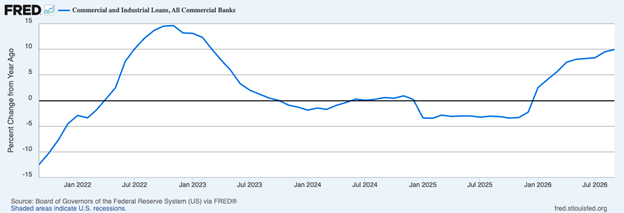
But there’s a caveat—much of the lending is flowing to one ‘theme’ in the economy. You guessed it, artificial intelligence. The upshot, however, is that the AI theme has beneficiaries across different sectors. Large banks are helping finance data centers and technology infrastructure, while regional lenders are extending credit to the construction companies, manufacturers, and equipment suppliers supporting the build-out. The acceleration is notable given higher interest rates and years of commercial lending shifting toward nonbank competitors (private credit). We should stop short of calling this a lending boom, however. Banks are also becoming more cautious, with executives expressing concerns about concentrated exposure to AI projects, complex financing arrangements, and the possibility that some planned investments may never materialize.
Is Inflation Putting Pressure on Your Retirement Plan? A strong economy doesn’t eliminate the challenges inflation can create for retirement savers. As the Fed weighs its next move, consider what you can do to account for inflation in your own retirement plan.
Download your complimentary copy of 4 Ways to Protect Your Retirement from Inflation² to explore practical strategies for your investment mix, spending, and retirement income, such as:
- How to build or modify your asset allocation to outperform inflation
- The importance of analyzing your spending by category
- Strategies to maximize Social Security retirement benefits
- Plus, more practical ideas to fight back against inflation
Claim your complimentary guide to explore ways to help your retirement savings go further.
Disclosure
2 Zacks Investment Management reserves the right to amend the terms or rescind the free 4 Ways to Protect Your Retirement from Inflation offer at any time and for any reason at its discretion.
3 Wall Street Journal. October 25, 2026. “U.S. Manufacturing Is Adding Jobs Again, but the Hiring Rules Have Changed.”
4 FRED, Federal Reserve Bank of St. Louis. October 2, 2026. “All Employees, Manufacturing (MANEMP).”
5 Wall Street Journal. October 28, 2026. “AI Boom Drives a Jump in Lending, but Bankers Still Sound Cautious.”
6 FRED, Federal Reserve Bank of St. Louis. October 23, 2026. “Commercial and Industrial Loans, All Commercial Banks (BUSLOANS).”
DISCLOSURE
Past performance is no guarantee of future results. Inherent in any investment is the potential for loss.
Zacks Investment Management, Inc. is a wholly-owned subsidiary of Zacks Investment Research. Zacks Investment Management is an independent Registered Investment Advisory firm and acts as an investment manager for individuals and institutions. Zacks Investment Research is a provider of earnings data and other financial data to institutions and to individuals.
This material is being provided for informational purposes only and nothing herein constitutes investment, legal, accounting or tax advice, or a recommendation to buy, sell or hold a security. Do not act or rely upon the information and advice given in this publication without seeking the services of competent and professional legal, tax, or accounting counsel. Publication and distribution of this article is not intended to create, and the information contained herein does not constitute, an attorney-client relationship. No recommendation or advice is being given as to whether any investment or strategy is suitable for a particular investor. It should not be assumed that any investments in securities, companies, sectors or markets identified and described were or will be profitable. All information is current as of the date of herein and is subject to change without notice. Any views or opinions expressed may not reflect those of the firm as a whole.
Any projections, targets, or estimates in this report are forward looking statements and are based on the firm’s research, analysis, and assumptions. Due to rapidly changing market conditions and the complexity of investment decisions, supplemental information and other sources may be required to make informed investment decisions based on your individual investment objectives and suitability specifications. All expressions of opinions are subject to change without notice. Clients should seek financial advice regarding the appropriateness of investing in any security or investment strategy discussed in this presentation.
Certain economic and market information contained herein has been obtained from published sources prepared by other parties. Zacks Investment Management does not assume any responsibility for the accuracy or completeness of such information. Further, no third party has assumed responsibility for independently verifying the information contained herein and accordingly no such persons make any representations with respect to the accuracy, completeness or reasonableness of the information provided herein. Unless otherwise indicated, market analysis and conclusions are based upon opinions or assumptions that Zacks Investment Management considers to be reasonable. Any investment inherently involves a high degree of risk, beyond any specific risks discussed herein.
The S&P 500 Index is a well-known, unmanaged index of the prices of 500 large-company common stocks, mainly blue-chip stocks, selected by Standard & Poor’s. The S&P 500 Index assumes reinvestment of dividends but does not reflect advisory fees. The volatility of the benchmark may be materially different from the individual performance obtained by a specific investor. An investor cannot invest directly in an index.
Questions posed are for demonstrative and informational purposes only and may not reflect the views of current clients or any one individual.