Are Investors Too Focused on AI?
In recent weeks, market volatility has returned to a degree we haven’t seen since the conflict broke out in Iran. Though volatility works both ways (up and down), investors have been attuned to the sharp selloffs, with the Nasdaq notably plunging 5.5% in a single session following the midterm elections. Wall Street’s ‘fear gauge,’ the CBOE Volatility Index (VIX), surged above 28 and remains elevated relative to what we’ve experienced in 2026.
CBOE Volatility Index, 2026
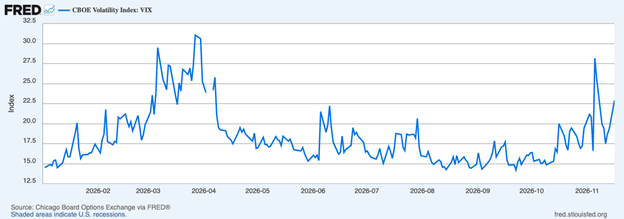
Source: Federal Reserve Bank of St. Louis1
Much of the uncertainty in markets has centered on the AI investment theme. Nvidia has been at the heart of that story, with its advanced chips providing much of the computing power on which the technology is being built. Its sudden leadership shakeup is particularly significant given the central role founder and longtime CEO Jensen Huang has played.
But before this was even a story, investors were growing increasingly concerned about data-center construction and AI regulation, given the mandate on AI that seemed to accompany the midterm election results. According to Ballotpedia’s initial November 6 tally, voters favored restrictions on data-center development in 40 of 41 local ballot contests across 10 states.2
Get a Clearer Picture of What’s Driving the Market
The recent selloff showed how quickly expectations for AI can shift.
Read our November Stock Market Outlook Report3 to see which economic developments could support stocks in the months ahead and which risks we’re watching. I recommend using the report as a reference when new economic data is released.
Inside includes:
- Asset allocation guidelines for today’s market environment
- Expert forecasts for inflation, rates, and economic trends
- Industry tables and rankings to help you spot opportunities
- Buy-side and sell-side consensus insights at a glance
- And much more!
Claim your complimentary copy of the report for a closer look at the fundamentals behind the market’s daily swings and what they could mean for your portfolio in the months ahead.
Download our November Stock Market Outlook Report3
The key question in markets today is whether the confluence of these forces will indeed thwart or slow the economic impact of the AI theme, from buildout all the way through to adoption and application.
The data I have suggests there could be a speed bump in AI’s trajectory, but not a wall. Nvidia’s latest earnings report, released November 17, showed quarterly revenue rising 103% year-over-year to $115.8 billion, with data-center revenue climbing 110% to $107.6 billion. Despite the company’s leadership uncertainty, demand for its products remains substantial. (To note, I do not make recommendations about individual securities, and I reference Nvidia here only to illustrate the broader trend.)
The hyperscalers are expected to spend more than $720 billion collectively on capital expenditures this year, much of it associated with AI infrastructure. That’s roughly three times their combined spending just two years ago.
Still, election results in municipalities made clear that communities are concerned about utility costs, water supplies, and local infrastructure. But I think the actual disruption may be smaller than the headlines and recent volatility suggest. According to an analysis by Bernstein, just 2%–4% of prospective data-center projects nationwide have the potential to be canceled, rising to 9% in the most extreme scenario.2 Delays may push some of AI’s economic gains further into the future, though their ultimate impact will depend on how effectively businesses adopt the technology.
Setting all of that aside, I think there’s another consideration for investors that deserves just as much attention: how much of the market’s outlook, and perhaps your own portfolio, is tied to the AI investment cycle?
As AI has become such a dominant market story, it’s easy to lose sight of the many other businesses generating earnings growth—not directly tied to the AI theme—in the economy today. According to our colleagues at Zacks Investment Research, third-quarter S&P 500 earnings were expected to grow 19.9% year-over-year excluding Technology. Even removing both Technology and Energy, earnings growth was projected at 10.5%.4
To be fair, industries such as utilities, construction, and industrial equipment manufacturing are also benefiting from the AI buildout, and their growth prospects may be influenced by its trajectory. But the U.S. economy is much broader than this one investment theme. Consumer Spending, Financials, Health Care, and other industries have their own sources of demand and earnings growth, independent of how quickly AI infrastructure expands.
Looking ahead, Zacks analysts have raised 2027 earnings estimates for 10 of the 16 Zacks sectors since early July, including Finance and Industrials. These are encouraging figures because they show that corporate profit growth is extending well beyond the companies at the center of the AI boom. A diversified portfolio can participate in the AI opportunity without becoming overly dependent on its success.4
Bottom Line for Investors
Periods of heightened volatility can create a sense of urgency, particularly when the headlines involve companies and industries that have played an outsized role in driving market returns. But urgency is rarely a good foundation for investment decisions.
I think investors should be mindful of the distinction between an industry experiencing a change in expectations and a broader deterioration in economic fundamentals. The two can certainly overlap, but they do not necessarily move together. The goal is to build a portfolio that can withstand unexpected developments without requiring investors to correctly predict which market theme will dominate next.
As you review your portfolio heading into year-end, consider which market risks it’s most exposed to. Download our November Stock Market Outlook Report3 for a look at the economic trends and market risks to watch in the months ahead.
You’ll get insights into:
- Asset allocation guidelines for today’s market environment
- Expert forecasts for inflation, rates, and economic trends
- Industry tables and rankings to help you spot opportunities
- Buy-side and sell-side consensus insights at a glance
- And much more!
Claim your complimentary copy of the report for a closer look at the fundamentals behind the market’s daily swings and what they could mean for your portfolio heading into 2027.
Download our November Stock Market Outlook Report3
Disclosure
2 New York Times. November 12, 2026. “Voters Rejected Data Centers. Many Will Be Built Anyway.”
3 Zacks Investment Management reserves the right to amend the terms or rescind the free November Stock Market Outlook Report offer at any time and for any reason at its discretion.
4 Zacks Investment Research. November 11, 2026. “Q3 Earnings Results Reconfirm Broad-Based Strength as Outlook Improves.”
DISCLOSURE
Past performance is no guarantee of future results. Inherent in any investment is the potential for loss.
Zacks Investment Management, Inc. is a wholly-owned subsidiary of Zacks Investment Research. Zacks Investment Management is an independent Registered Investment Advisory firm and acts as an investment manager for individuals and institutions. Zacks Investment Research is a provider of earnings data and other financial data to institutions and to individuals.
This material is being provided for informational purposes only and nothing herein constitutes investment, legal, accounting or tax advice, or a recommendation to buy, sell or hold a security. Do not act or rely upon the information and advice given in this publication without seeking the services of competent and professional legal, tax, or accounting counsel. Publication and distribution of this article is not intended to create, and the information contained herein does not constitute, an attorney-client relationship. No recommendation or advice is being given as to whether any investment or strategy is suitable for a particular investor. It should not be assumed that any investments in securities, companies, sectors or markets identified and described were or will be profitable. All information is current as of the date of herein and is subject to change without notice. Any views or opinions expressed may not reflect those of the firm as a whole.
Any projections, targets, or estimates in this report are forward looking statements and are based on the firm’s research, analysis, and assumptions. Due to rapidly changing market conditions and the complexity of investment decisions, supplemental information and other sources may be required to make informed investment decisions based on your individual investment objectives and suitability specifications. All expressions of opinions are subject to change without notice. Clients should seek financial advice regarding the appropriateness of investing in any security or investment strategy discussed in this presentation.
Certain economic and market information contained herein has been obtained from published sources prepared by other parties. Zacks Investment Management does not assume any responsibility for the accuracy or completeness of such information. Further, no third party has assumed responsibility for independently verifying the information contained herein and accordingly no such persons make any representations with respect to the accuracy, completeness or reasonableness of the information provided herein. Unless otherwise indicated, market analysis and conclusions are based upon opinions or assumptions that Zacks Investment Management considers to be reasonable. Any investment inherently involves a high degree of risk, beyond any specific risks discussed herein.
The S&P 500 Index is a well-known, unmanaged index of the prices of 500 large-company common stocks, mainly blue-chip stocks, selected by Standard & Poor’s. The S&P 500 Index assumes reinvestment of dividends but does not reflect advisory fees. The volatility of the benchmark may be materially different from the individual performance obtained by a specific investor. An investor cannot invest directly in an index.
The Nasdaq Composite Index measures all Nasdaq domestic and international based common type stocks listed on The Nasdaq Stock Market. To be eligible for inclusion in the Index, the security's U.S. listing must be exclusively on The Nasdaq Stock Market (unless the security was dually listed on another U.S. market prior to January 1, 2004 and has continuously maintained such listing). The security types eligible for the Index include common stocks, ordinary shares, ADRs, shares of beneficial interest or limited partnership interests and tracking stocks. Security types not included in the Index are closed-end funds, convertible debentures, exchange traded funds, preferred stocks, rights, warrants, units and other derivative securities. An investor cannot invest directly in an index.
The CBOE Volatility Index (VIX) is a calculation designed to produce a measure of constant, 30-day expected volatility of the U.S. stock market, derived from real-time, mid-quote prices of S&P 500 Index call and put options. On a global basis, it is one of the most recognized measures of volatility -- widely reported by financial media and closely followed by a variety of market participants as a daily market indicator. The volatility of the benchmark may be materially different from the individual performance obtained by a specific investor. An investor cannot invest directly in an index.